26 Nov 2026
Best Machine Learning Frameworks in 2027: TensorFlow vs PyTorch vs Scikit-Learn
By DSC Next
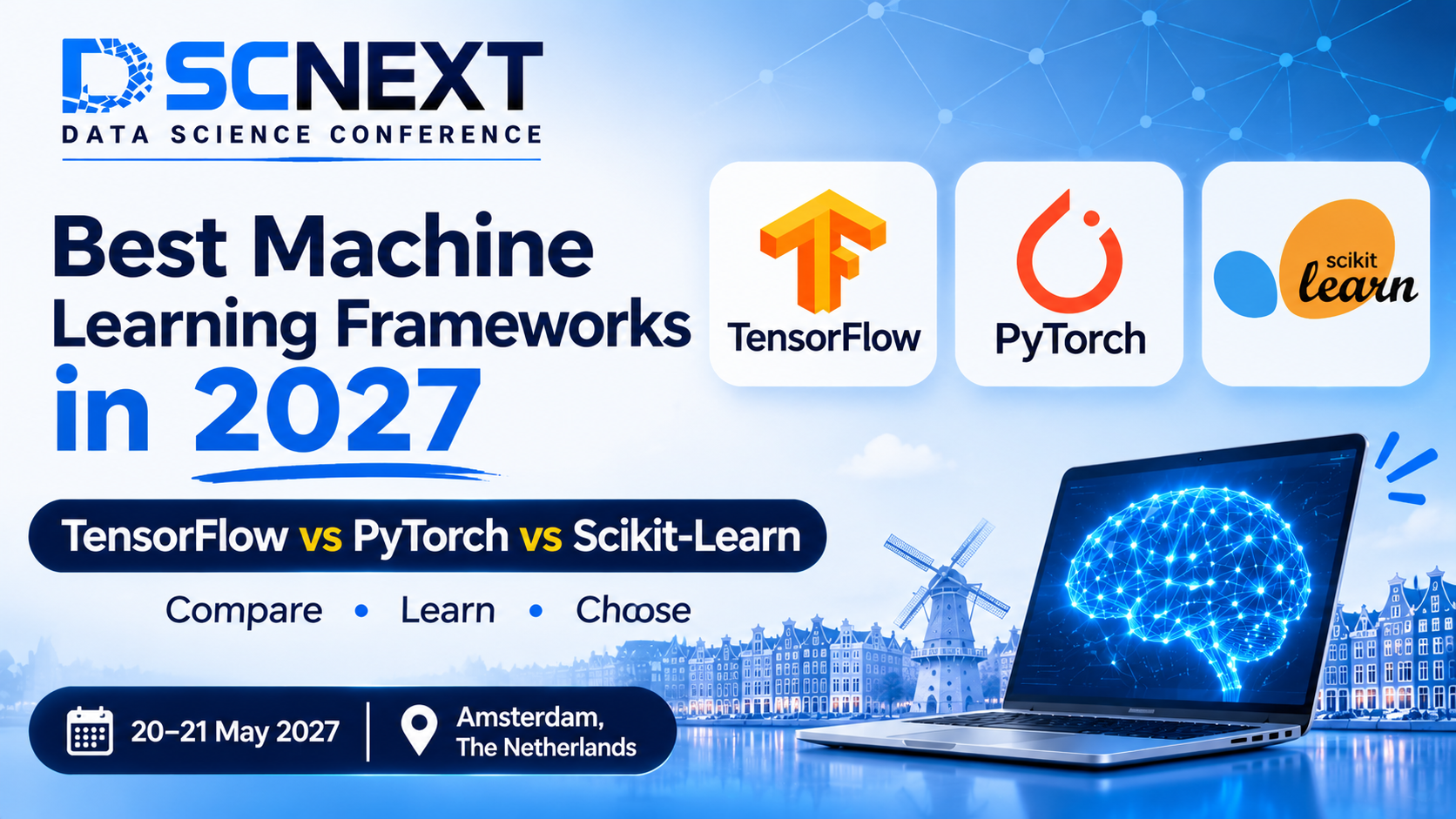
Best Machine Learning Frameworks in 2027: TensorFlow vs PyTorch vs Scikit-Learn
Meta Title: Best Machine Learning Frameworks in 2027: TensorFlow vs PyTorch vs Scikit-Learn
Meta Description: Compare TensorFlow, PyTorch, and Scikit-Learn in 2027. Explore features, performance, deployment, ease of learning, and discover which machine learning framework is best for your projects.
Suggested URL: best-machine-learning-frameworks-2027
Target Keywords: TensorFlow vs PyTorch, Scikit-Learn vs TensorFlow, best machine learning frameworks, machine learning libraries 2027, PyTorch for beginners.
Category: Artificial Intelligence / Machine Learning / Data Science
Introduction: Choosing the Right Machine Learning Framework in 2027
Machine learning has become an important part of modern software development, scientific research, business analytics, and artificial intelligence. From recommendation systems and fraud detection to computer vision and generative AI, developers rely on specialized frameworks to build, train, evaluate, and deploy machine learning models.
However, choosing the right framework can be challenging, particularly when several popular options offer different capabilities.
Three names consistently stand out in the machine learning ecosystem: TensorFlow, PyTorch, and Scikit-Learn.
Although all three support machine learning development, they are designed for different types of work.
TensorFlow provides a broad ecosystem for developing and deploying machine learning and deep learning applications.
PyTorch offers a flexible, Python-oriented environment widely used in deep learning research and development.
Scikit-Learn provides accessible and practical tools for traditional machine learning, statistical modelling, and data analysis.
There is no universally best framework. The right choice depends on the complexity of your project, your technical experience, available computing resources, and deployment requirements.
This guide compares TensorFlow vs PyTorch vs Scikit-Learn across their features, strengths, weaknesses, learning requirements, performance considerations, and real-world applications.
1. What Are Machine Learning Frameworks?
A machine learning framework is a collection of software tools, libraries, and functions that helps developers create, train, evaluate, and deploy machine learning models.
Building a machine learning model from scratch requires implementing mathematical operations, optimization techniques, data processing procedures, and model evaluation methods.
Frameworks simplify these tasks by providing ready-to-use components.
For example, imagine an online shopping company that wants to predict which products customers are likely to purchase.
A machine learning developer can use a framework to:
Import and prepare customer information.
Select an appropriate algorithm.
Train the model using historical purchases.
Evaluate its prediction quality.
Integrate the model into an application.
Different frameworks support different approaches. Some focus on traditional algorithms, while others provide advanced capabilities for neural networks and large-scale deep learning.
This is why understanding the differences between TensorFlow, PyTorch, and Scikit-Learn is important before selecting a technology for a project.
2. TensorFlow: A Complete Ecosystem for Machine Learning
What Is TensorFlow?
<text>TensorFlow</text> is an open-source machine learning framework originally developed by Google. It provides tools for building, training, evaluating, and deploying machine learning models across different computing environments.
TensorFlow is particularly useful for deep learning applications, distributed training, and production-oriented machine learning workflows.
Its ecosystem includes Keras, TensorBoard, TensorFlow Serving, TensorFlow.js, LiteRT, and TensorFlow Extended (TFX).
Key Features of TensorFlow
1. Deep Learning Development
TensorFlow supports neural networks and advanced deep learning architectures used in image recognition, natural language processing, speech processing, and other AI applications.
Developers can use Keras to construct and train models with a relatively simple programming interface.
2. Distributed Training
TensorFlow provides tools for distributing model training across multiple devices and machines.
This can be useful when working with large datasets or computationally demanding models.
3. Model Deployment
One of TensorFlow's major strengths is its deployment ecosystem.
TensorFlow Serving supports production model serving.
LiteRT supports deployment on mobile and edge devices.
TensorFlow.js supports machine learning applications in web browsers.
TFX provides tools for production machine learning pipelines.
These capabilities allow organizations to develop models and integrate them into different applications.
4. Visualization and Monitoring
TensorBoard helps developers visualize training metrics, model graphs, and other information during model development.
Advantages of TensorFlow
Comprehensive machine learning ecosystem.
Strong deep learning capabilities.
Multiple deployment options.
Support for distributed training.
Integration with Keras.
Extensive tutorials and documentation.
Disadvantages of TensorFlow
The wider ecosystem can feel complicated to beginners.
Advanced customization may require understanding several TensorFlow concepts.
Debugging complex workflows can require additional experience.
Some projects may not need its extensive deployment infrastructure.
Ease of Learning
TensorFlow is accessible to beginners through Keras, but learning its broader ecosystem requires time.
For someone starting with neural networks, Keras provides a convenient introduction without requiring developers to implement every mathematical operation manually.
Practical Example: Image Classification
Imagine developing an application that identifies different types of flowers from photographs.
A TensorFlow model can learn from labelled images, recognize visual patterns, and classify new photographs.
TensorFlow is a strong option when the application also requires deployment across mobile, web, or cloud environments.
Current Version and Ecosystem
As of 26 November 2026, TensorFlow 2.21.0 is the latest stable release identified in its official release repository. TensorFlow 2.22.0-rc1 is available as a prerelease, so production teams should distinguish it from the stable version.
The 2.21 release includes updates to LiteRT and image processing capabilities.
Official resources:
3. PyTorch: Flexibility for Deep Learning and AI Research
What Is PyTorch?
<text>PyTorch</text> is an open-source machine learning framework maintained by the PyTorch Foundation. It is widely used by researchers, developers, and machine learning engineers for deep learning experimentation and model development.
PyTorch is known for its Python-friendly programming experience and flexible approach to building neural networks.
It provides tools for automatic differentiation, GPU computation, model training, and deployment.
Key Features of PyTorch
1. Dynamic Computation
PyTorch uses dynamic computation graphs, allowing developers to execute operations and inspect intermediate results during model development.
This makes experimentation and debugging convenient, particularly when developing complex neural networks.
2. Automatic Differentiation
PyTorch's autograd system automatically calculates gradients needed to train neural networks.
Developers do not need to manually calculate every derivative during the training process.
3. GPU Acceleration
PyTorch supports GPU computation, allowing compatible workloads to use supported hardware accelerators.
This can significantly reduce training time when a suitable GPU and optimized implementation are available.
4. Deep Learning Ecosystem
PyTorch integrates with a broad collection of tools and libraries, including:
TorchVision for computer vision.
TorchAudio for audio processing.
TorchText-related ecosystem tools and alternatives.
Hugging Face Transformers for pretrained models.
DeepSpeed and related distributed training tools.
5. Model Compilation and Export
PyTorch 2.x includes torch.compile, which can optimize supported model execution.
Its torch.export functionality provides a way to capture models into exportable computational graphs for supported deployment workflows.
Advantages of PyTorch
Flexible model development.
Python-friendly programming interface.
Strong research and experimentation capabilities.
Automatic differentiation.
GPU and distributed training support.
Extensive open-source ecosystem.
Useful integration with modern AI development tools.
Disadvantages of PyTorch
Beginners need to understand tensors, gradients, and neural network concepts.
Production deployment may require additional engineering tools.
Performance depends on model design, hardware, and optimization.
Complex distributed training systems require specialized knowledge.
Ease of Learning
PyTorch is particularly attractive to Python developers.
Its programming style allows developers to define models using familiar Python classes and functions.
However, understanding deep learning concepts remains necessary. PyTorch simplifies implementation, but it does not eliminate the mathematics behind neural networks.
Practical Example: Developing a Neural Network
Suppose a research team wants to develop an image recognition model that identifies defective products on a manufacturing production line.
Using PyTorch, developers can:
Load and prepare image datasets.
Design a convolutional neural network.
Train the model using labelled images.
Evaluate classification performance.
Experiment with different architectures.
Export the trained model for an appropriate deployment environment.
This flexibility makes PyTorch particularly useful for experimental AI development.
Current Version and Ecosystem
As of 26 November 2026, PyTorch 2.15 is the latest stable release identified on the official PyTorch website. It was released on 28 October 2026.
Its improvements include distributed training enhancements, updated GPU support, memory and communication optimizations, and expanded hardware compatibility.
The release also continues PyTorch's development as a platform for production training and inference rather than only research experimentation.
Official resources:
4. Scikit-Learn: A Beginner-Friendly Framework for Traditional Machine Learning
What Is Scikit-Learn?
<text>Scikit-Learn</text> is an open-source Python machine learning library designed for traditional machine learning, statistical modelling, data preprocessing, and model evaluation.
Unlike TensorFlow and PyTorch, Scikit-Learn primarily focuses on established machine learning algorithms rather than building complex deep neural networks.
It is especially useful for beginners, data analysts, students, and data scientists working with structured datasets.
Key Features of Scikit-Learn
1. Traditional Machine Learning Algorithms
Scikit-Learn includes many widely used algorithms, such as:
Linear Regression.
Logistic Regression.
Decision Trees.
Random Forest.
Support Vector Machines.
K-Nearest Neighbours.
K-Means Clustering.
Gradient Boosting.
These algorithms can be applied to classification, regression, clustering, and other machine learning tasks.
2. Data Preprocessing
Before training a model, developers often need to clean and transform their datasets.
Scikit-Learn provides tools for:
Handling missing values.
Feature scaling.
Encoding categorical variables.
Feature selection.
Dimensionality reduction.
3. Model Evaluation
Scikit-Learn includes tools for evaluating machine learning performance.
Developers can calculate accuracy, precision, recall, F1-score, and other relevant metrics.
4. Pipelines and Model Selection
Its Pipeline functionality combines preprocessing and model training into a single workflow.
Grid search and cross-validation tools help developers compare models and tune hyperparameters.
Advantages of Scikit-Learn
Easy-to-understand API.
Excellent for traditional machine learning.
Suitable for beginners.
Extensive preprocessing tools.
Strong model evaluation capabilities.
Convenient integration with NumPy and Pandas.
Useful documentation and learning resources.
Disadvantages of Scikit-Learn
Not designed as a general-purpose deep learning framework.
Does not provide the same native neural network development capabilities as TensorFlow or PyTorch.
Not intended for large-scale distributed deep learning.
GPU acceleration is not a general built-in feature across its estimators.
Ease of Learning
Scikit-Learn is generally the easiest starting point among these three frameworks for traditional machine learning.
Its consistent API allows developers to train different algorithms using similar commands.
For example, a developer can use the same basic workflow to train a decision tree, logistic regression model, or random forest.
Practical Example: Customer Churn Prediction
Imagine a telecommunications company wants to identify customers who may cancel their subscriptions.
The company has a dataset containing:
Customer age.
Subscription duration.
Monthly charges.
Number of complaints.
Service usage.
Previous cancellation records.
A data scientist can use Scikit-Learn to prepare the dataset, train a classification model, and evaluate its ability to identify customers at risk of leaving.
This is a practical example of how traditional machine learning can solve real business problems.
Current Version and Ecosystem
As of November 2026, Scikit-Learn 1.9.1 is the latest stable release identified in its official release history.
The September 2026 release includes fixes and improvements involving metadata routing, model pipelines, and array API compatibility.
Scikit-Learn continues to provide a mature ecosystem for supervised learning, unsupervised learning, preprocessing, model selection, and evaluation.
Official resources:
5. TensorFlow vs PyTorch vs Scikit-Learn: Detailed Comparison
Although these frameworks overlap in certain areas, their strengths differ significantly.
The following table summarizes their most important characteristics.
| Feature | TensorFlow | PyTorch | Scikit-Learn |
|---|---|---|---|
| Primary focus | ML and deep learning ecosystem | Deep learning and AI development | Traditional machine learning |
| Main language | Python, C++, JavaScript ecosystem | Python, C++ | Python |
| Learning difficulty | Moderate | Moderate | Beginner-friendly |
| Neural networks | Yes | Yes | Limited MLP support |
| Deep learning | Extensive | Extensive | Not its primary purpose |
| GPU acceleration | Yes | Yes | Limited estimator-level support |
| Data preprocessing | Yes | Usually through ecosystem tools | Extensive |
| Model evaluation | Yes | Yes | Extensive |
| Distributed training | Supported | Supported | Not a core capability |
| Production deployment | Broad deployment ecosystem | Export and deployment ecosystem | Usually integrated into Python applications |
| Best-known ecosystem | Keras, TFX, TensorFlow Serving | TorchVision, TorchAudio, Hugging Face | NumPy, Pandas, SciPy |
Important: This comparison describes typical capabilities, not a performance ranking. Actual results depend on the algorithm, dataset, hardware, software versions, implementation, and deployment environment.
6. Performance: Which Framework Is Faster?
Performance is one of the most common questions developers ask when comparing machine learning frameworks.
However, there is no universally fastest framework.
The answer depends on what you are building and how you measure performance.
TensorFlow Performance
TensorFlow offers optimization and deployment capabilities through its ecosystem, including XLA-related compilation, distributed training, and hardware-specific acceleration.
Its performance can be useful for large-scale neural networks and production workflows.
PyTorch Performance
PyTorch supports GPU acceleration, distributed training, and model compilation through torch.compile.
Its latest development also includes advanced optimizations for large-scale training and inference.
Scikit-Learn Performance
Scikit-Learn is often an efficient choice for traditional machine learning problems involving structured datasets.
For example, a random forest or logistic regression model may be more appropriate than a deep neural network for a relatively small business dataset.
Using a deep learning framework does not automatically improve accuracy or execution speed.
What Should Developers Measure?
When comparing frameworks, consider:
Model training time.
Prediction latency.
Memory consumption.
Hardware utilization.
Model accuracy.
Deployment requirements.
Maintenance complexity.
A fair comparison should use the same dataset, equivalent model architectures where possible, consistent preprocessing, and appropriate hardware.
7. Which Framework Should You Choose?
The best machine learning framework depends on your experience, project requirements, and career goals.
For Beginners: Start with Scikit-Learn
Scikit-Learn is a practical starting point for anyone learning machine learning.
It helps beginners understand important concepts such as classification, regression, clustering, model evaluation, and feature engineering.
Recommended first project: Build a house price prediction model using a public dataset.
Once you understand traditional machine learning, you can move toward deep learning using PyTorch or TensorFlow.
For AI Researchers: Choose PyTorch
PyTorch is a strong option for researchers experimenting with neural networks, custom architectures, computer vision, and natural language processing.
Its flexible development approach makes it convenient for testing new ideas and modifying model components.
Recommended project: Develop and compare different neural network architectures for image classification.
For Production Teams: Consider TensorFlow
TensorFlow is particularly attractive when an organization needs a broader machine learning deployment ecosystem.
Its serving, mobile, web, and pipeline tools can support applications across multiple environments.
Recommended project: Build an image recognition application and deploy it using an appropriate TensorFlow serving or edge deployment workflow.
This does not mean TensorFlow is the only production option. PyTorch also supports production training and inference, and the best choice depends on the team's infrastructure and engineering requirements.
For Experienced Machine Learning Engineers: Learn Both TensorFlow and PyTorch
Experienced engineers benefit from understanding multiple frameworks.
PyTorch can be useful for model development and experimentation, while TensorFlow provides a broad set of deployment and production tools.
Knowing both can help engineers evaluate technology choices more effectively.
Scikit-Learn should also remain part of the toolkit for preprocessing, traditional algorithms, and model evaluation.
8. Can You Use All Three Frameworks in One Project?
Yes. In fact, using multiple machine learning libraries within the same project can be a practical approach.
Consider an intelligent manufacturing system that identifies defective products using images and production data.
A possible workflow could be:
Step 1: Data Preparation
Use Pandas and Scikit-Learn preprocessing tools to clean structured production information and prepare numerical features.
Step 2: Model Development
Use PyTorch to develop a neural network that identifies visual defects in product images.
Step 3: Model Evaluation
Use appropriate evaluation methods to compare the image model and traditional machine learning models.
Step 4: Deployment
Export the trained model using an appropriate supported format and integrate it into the production application.
TensorFlow or PyTorch could be used for the deployment workflow depending on the selected architecture and infrastructure.
The important point is that machine learning frameworks are tools, not competing technologies that must always be used separately.
However, combining frameworks introduces integration, dependency, and maintenance complexity. Use multiple tools only when their individual capabilities justify the additional engineering work.
9. Skills Developers Should Learn Alongside Machine Learning Frameworks
Learning a framework is only one part of becoming a machine learning professional.
Developers should also build a strong foundation in the following areas.
Python Programming: Understand functions, classes, data structures, libraries, and error handling.
Mathematics and Statistics: Learn probability, linear algebra, calculus fundamentals, and statistical reasoning.
Data Analysis: Become comfortable with NumPy, Pandas, data visualization, and data preprocessing.
Machine Learning Fundamentals: Understand supervised learning, unsupervised learning, overfitting, underfitting, and model evaluation.
Deep Learning: Learn neural networks, backpropagation, activation functions, and optimization.
Cloud and Deployment: Understand APIs, Docker, cloud computing, model serving, and monitoring.
Problem-Solving: Learn to select algorithms based on actual business or research problems rather than simply choosing the most popular framework.
Practical experience is particularly valuable. Building and documenting projects helps demonstrate that you understand how to apply machine learning concepts beyond tutorials.
Conclusion: Which Machine Learning Framework Is Best in 2027?
TensorFlow, PyTorch, and Scikit-Learn each play an important role in the machine learning ecosystem.
Scikit-Learn is an excellent starting point for traditional machine learning, structured datasets, and business analytics.
PyTorch is a strong choice for deep learning research, flexible neural network development, and modern AI experimentation.
TensorFlow provides a comprehensive ecosystem for machine learning development, distributed training, and deployment across different environments.
Rather than asking which framework is the best overall, developers should ask which framework is best suited to their specific problem.
For beginners, starting with Scikit-Learn can provide a solid foundation. As projects become more complex, learning PyTorch and TensorFlow can open opportunities in deep learning, AI research, and production machine learning.
The future of machine learning will depend not only on frameworks but also on the professionals who understand how to use them responsibly and effectively.
To explore emerging technologies, exchange knowledge with researchers and industry professionals, and discover new developments in artificial intelligence and data science, join DSC Next Conference 2027 – 3rd Edition, taking place on 20–21 May 2027 in Amsterdam, The Netherlands.
Connect with the data science community and explore how machine learning frameworks, intelligent applications, and emerging technologies are shaping the future of AI.
Learn the fundamentals, experiment with the tools, and build solutions that make a difference.
References and Official Documentation
Version note: Framework versions and release information in this article were checked against official project sources on 26 November 2026. Check the official installation pages for the latest compatible versions of Python, CUDA, and other dependencies before starting a project.